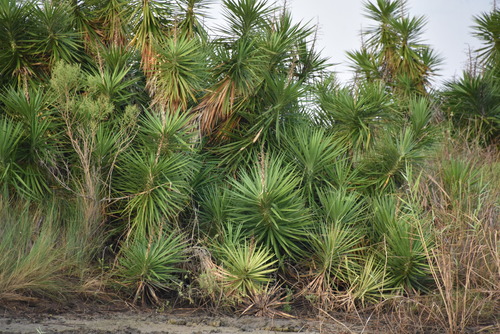
Itilizasyon Peyizaj
Etikèt Estil
Gid Kwasans pou Sid Florid
Bezwen Limyè
Bezwen Dlo
Once established (12–18 months), Spanish Bayonet is drought-tolerant and requires minimal supplemental irrigation in South Florida.
Virtually no supplemental irrigation needed once established. Water 1-2x per week for first 3-6 months of establishment only. After establishment, rainwater is entirely sufficient in South Florida. Overwatering is a primary failure cause — excellent drainage is essential.
Tè ak Fètilizasyon
Fertilizer: Light balanced slow-release fertilizer — minimal need
Schedule: Generally not required — coastal sandy soil native. Light slow-release fertilizer in February if deficiency observed.
Tolerans Sèl
Suitable for coastal planting across all 5 South Florida counties.
- Wotè Matire
- 6–15 ft
- Lajè Matire
- 3–6 ft
- Vitès Kwasans
- slow
- Bezwen Dlo
- 1/10
- Nòt Florida
- Florida
- Pri Enstalasyon
- $
- Zòn USDA
- 7b, 8a, 8b, 9a, 9b, 10a, 10b, 11
- Estati FLEPPC
- None
- Nòt Iguàn
- 9/10
Kote pou Achte nan Sid Florid
Jwenn Spanish Bayonet nan pepinyè Sid Florid — verifye disponiblite ak pri nan pepinyè pre ou.
Kesyon Souvan Poze
How fast does Spanish Bayonet grow in South Florida?
Spanish Bayonet has a slow growth rate. In South Florida's warm, humid climate it typically establishes quickly with proper watering and fertilization.
Is Spanish Bayonet safe for pets?
Spanish Bayonet is not safe for pets. Spine hazard — terminal spines cause puncture injuries. Saponins in leaves are toxic to dogs and cats if ingested — causes vomiting and GI distress. Not suitable for pet-accessible areas.
How much water does Spanish Bayonet need in South Florida?
Low water needs (1/10). Once established (12–18 months), Spanish Bayonet is drought-tolerant and requires minimal supplemental irrigation in South Florida.
Can Spanish Bayonet tolerate salt air in South Florida?
Spanish Bayonet has high salt tolerance (9/10) and is well-suited for coastal South Florida, including areas with salt air in Miami-Dade, Broward, Palm Beach, Collier, and Monroe counties.
Is Spanish Bayonet available in Miami-Dade County?
In Miami-Dade County, Spanish Bayonet is classified as: allowed. Florida native — allowed and protected from HOA prohibition under Florida Statute 720.
Disponiblite pa Konte nan Sid Florid
Miami-Dade County
Florida native — allowed and protected from HOA prohibition under Florida Statute 720.3075.
✓ Bon pou Kòt
USDA Zone 10a–11. Tropical climate, year-round warmth and humidity.
Wè Gid Konte →Broward County
Florida native — allowed. Appropriate for coastal buffer plantings with no pedestrian access.
✓ Bon pou Kòt
USDA Zone 10a–10b. Subtropical with warm winters and wet/dry seasons.
Wè Gid Konte →Palm Beach County
Florida native — allowed. Appropriate for coastal buffer zones with no foot traffic.
✓ Bon pou Kòt
USDA Zone 9b–10b. Transitional zone with occasional winter cold in north.
Wè Gid Konte →Collier County
Florida native — allowed. Appropriate for Collier coastal buffer and xeriscape applications with no pedestrian access.
✓ Bon pou Kòt
USDA Zone 10a–10b. Subtropical Gulf Coast with seasonal flooding.
Wè Gid Konte →Monroe County
Florida native — allowed. Excellent salt and wind performance for Keys coastal properties.
✓ Bon pou Kòt
USDA Zone 11. Tropical maritime, highest salt exposure of all 5 counties.
Wè Gid Konte →Toujou verifye egzijans konte aktyèl anvan enstalasyon.
Ask about Spanish Bayonet
Get answers grounded in UF/IFAS research and South Florida landscape data.